Eukaryotic Gene Structure (Overview)
April 4, 2026
What is an eukaryotic cell ?
An eukaryotic cell is any cell or organism that possesses a clearly defined nucleus. The eukaryotic cell has a nuclear membrane that surrounds the nucleus, in which the well-defined chromosomes (bodies containing the hereditary material) are located. Eukaryotic cells also contain organelles, including mitochondria (cellular energy exchangers), a Golgi apparatus (secretory device), an endoplasmic reticulum (a canal-like system of membranes within the cell), and lysosomes (digestive apparatus within many cell types) [1]
Gene Structure in Eukaryotes
The DNA (DeoxyriboNucleic Acid) in eukaryotes is organized into linear chromosomes located within the nucleus. Genes are segments of this DNA that code for specific proteins or functional RNA molecules. [2]
The RNA (Ribonucleic Acid) is a polymer made up of ribonucleotides. It is found is the cytoplasm, nucleus and in the ribosome. The RNA is critical for the transmission of the genetic code that is necessary for protein creation from the nucleus to the ribosome.
-> Type of RNA
Only some of the genes in cells are expressed into RNA. The following are the types of RNA wherein each type is encoded by its own type of gene:
- tRNA : The transfer RNA or the tRNA, carries amino acids to ribosomes while translation.
- mRNA: The messenger RNA or the mRNA encodes amino acid sequences of a polypeptide.
- rRNA: The ribosomal RNA or the rRNA, produces ribosomes with the ribosomal proteins that are organelles responsible for the translation of the mRNA.
- snRNA: The small nuclear RNA or the snRNA, forms the complexes along with proteins which are utilized in RNA processing in the eukaryotes.
-> Exons and Introns
Exons and introns are section of the DNA within the eukaryote genes. Exons are the coding regions that contain instructions for protein synthesis. Introns are the non-coding regions that are removed during RNA processing.
During gene expression, a process by which information stored in the DNA is converted into functional products such as proteins or RNA, introns are spliced out of the pre-mRNA, and exons are joined together to form the mature mRNA. which is then translated into a protein. [3]
Central Dogma
Central Dogma of molecular biology is a theory stating that genetic information flows only in one direction, from DNA, to RNA, to protein, or RNA directly to protein.
-> Transcription and Translation
Transcription and Translation are the two-step that converts genetic information from DNA into functional proteins:
Transcription occurs in the nucleus, where RNA polymerase copies DNA into messenger RNA (mRNA).
Translation occurs in the cytoplasm, where ribosomes read mRNA to assemble amino acids into proteins.
-> Differences Between Genomic DNA and Mature mRNA
While genomic DNA contains both coding (exons) and non-coding (introns) sequences, the mature mRNA is a processed version that lacks introns and contains only the coding information necessary for protein synthesis.
RNA Processing (Beyond splicing)
In bacterial cells, the mRNA can be translated directly as it comes off to the DNA template. In eukaryotic cells, RNA synthesis, which occurs in the nucleus, is separated from the protein synthesis machinery, which is in the cytoplasm.
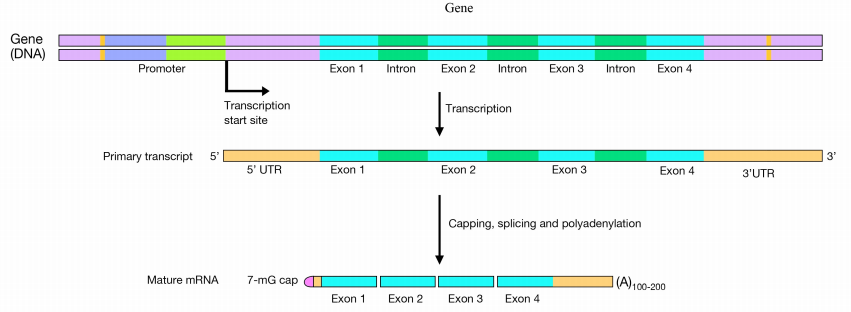
We saw earlier that transcription results in pre-mRNA. That pre-mRNA undergoes several modifications before becoming mature mRNA. These modifications include the addition of a 5’ cap and a 3’ poly-A tail, as well as the removal of introns through splicing.
-> Capping
In the capping step of the mRNA processing, a methylated-guanosine (7-methyl-G) is linked to the phosphates at the 5’ end of the mRNA. The cap protects the 5’ end of the mRNA from degradation by nucleases and also helps to position the mRNA correctly on the ribosomes during protein synthesis.
-> Poly(A) tail addition
The 3’ end of a eukaroytic mRNA is first trimmed, then an enzyme called Poly(A) Polymerase adds a “tail” of about 200 ‘A’ nucleotides to the 3’ end. The cap and the poly(A) tail help to stabilize the mRNA and facilitate its translation, and also indicate that the mRNA is complete (i.e, not defective).
-> Splicing
The splicing appears to occur as the transcript is being synthesized. Introns are removed from the pre-mRNA by the activity of a complex called the spliceosome.
The spliceosome is made up of proteins and small nuclear RNAs (snRNAs) that associate to form protein-RNA enzymes called small nuclear ribonucleoproteins or snRNPs. The splicing machinery must be able to recognize sequences that are specific to splice junctions (i.e., the end of each exon and the start of the next) in order to correctly cut out the introns and join the exons together to make the mature, spliced mRNA.
Mature mRNA components
While introns (non-coding regions) are removed during RNA processing, the mature mRNA that leaves the nucleus contains:
Exons: The coding sequences that contain the instructions for protein synthesis.
5’ UTR (Untranslated Region): A sequence at the beginning of the mRNA that is not translated into protein, but plays a key role in regulating translation.
3’ UTR (Untranslated Region): A sequence at the end of the mRNA involved in stability and regulation.
5’ Cap: A modified nucleotide added to the front for protection and recognition.
Poly-A Tail: A long sequence of adenine nucleotides added to the end for stability and export from the nucleus.
Conclusion
In summary, the journey from eukaryotic genomic DNA to a functional protein relies heavily on the intricate processing of the initial RNA transcript. The genetic code is heavily fragmented by non-coding introns, requiring the spliceosome to meticulously edit the pre-mRNA. The most fascinating takeaway from this process is that the final, mature mRNA is a precisely stitched-together sequence of exons that does not exist in that contiguous form anywhere in the actual DNA genome. This modular arrangement not only highlights the complexity of eukaryotic gene expression but also sets the stage for advanced genetic flexibility, where a single gene can produce multiple different proteins.
Reference
[1]: Britannica Editors. “eukaryote.” Encyclopedia Britannica, March 21, 2026. https://www.britannica.com/science/eukaryote.
[2]: Britannica Editors. “DNA.” Encyclopedia Britannica, April 3, 2026. https://www.britannica.com/science/DNA.